
X
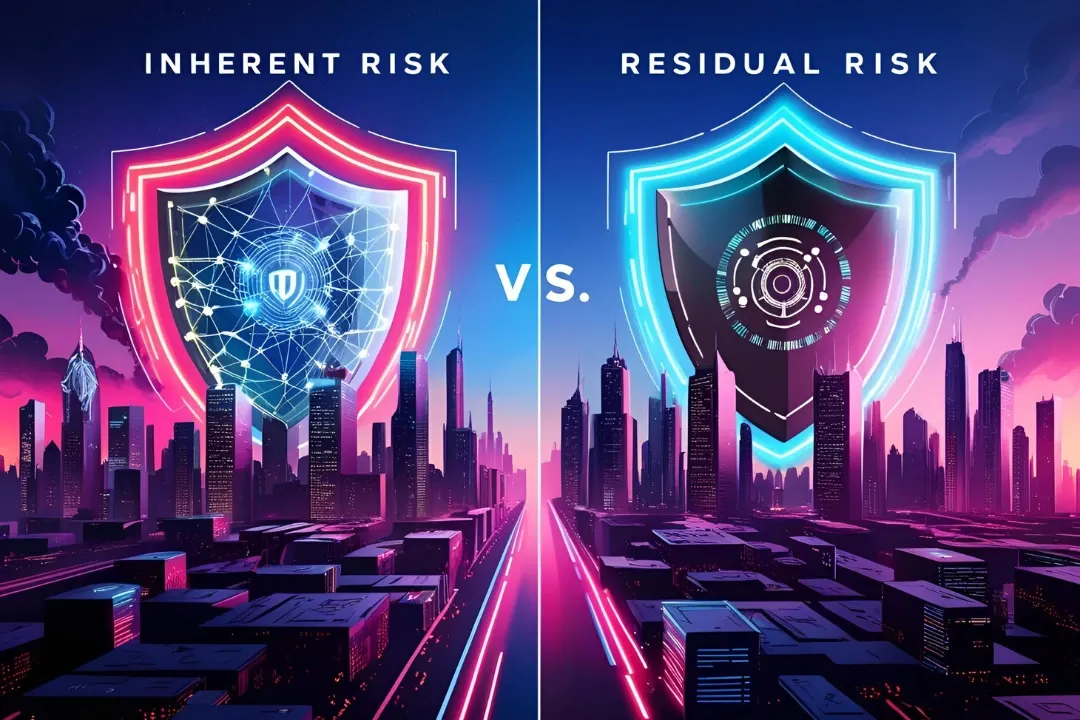
Despite advancements in security technology, businesses continue to fall victim to sophisticated cybercriminals who exploit network, software, and even human behaviour vulnerabilities. To effectively manage cybersecurity threats, businesses must understand two key types of risk: inherent risk and residual risk.
Inherent risk is the natural level of exposure a business faces before any security measures are applied. It includes threats like cyberattacks, data breaches, and system vulnerabilities that exist due to the industry, technology, or processes in place. Once security controls and risk mitigation strategies are implemented, some risk still remains—this is known as residual risk.
Failing to manage these risks effectively can lead to devastating consequences, from financial losses to increased supply chain vulnerabilities. Let’s explore the difference between inherent and residual risk, why they matter, and how to mitigate them.
Want to know more about what is inherent risk? And what is residual risk? We’ve outlined their key differences to help you understand how they impact cybersecurity:
Aspect | Inherent Risk | Residual Ris |
|---|---|---|
| Predictability | More predictable since it is based on known vulnerabilities and threats. | Less predictable as it depends on how effective the security measures are and how threats evolve. |
| Regulatory Compliance | Used mainly for initial risk assessments to identify vulnerabilities. | Often required to be documented and monitored in compliance frameworks (e.g., ISO 27001). |
| Control Dependence | Exists independently of any security controls. | Exists only after security controls have been applied. |
| Time Sensitivity | Identified at the beginning of risk assessments and security planning. | Requires continuous monitoring and adaptation as threats evolve. |
Awareness of what is residual risk and inherent risk is step one. Now, let’s explore why actively managing them is crucial for protecting your business:
Cyberattacks, data breaches, and security incidents can result in significant financial losses, including ransom payments, legal fees, and fines. Businesses can minimize potential damage and avoid costly disruptions by reducing inherent risk and monitoring residual risk.
Unmanaged risks can lead to operational downtime, which can affect productivity and service delivery. Businesses can maintain smooth operations and minimize downtime by addressing inherent risks early and monitoring residual risks.
Not all threats come from external hackers—employees or contractors can pose risks, too. Whether intentional (fraud) or accidental (misconfigured settings), insider risks must be monitored and controlled. Strong access controls and monitoring help reduce this vulnerability.
As businesses adopt cloud computing, AI, and IoT, they introduce new risks. Managing inherent and cyber sec residual risk ensures that these technologies integrate securely. This way, companies can embrace innovation without exposing themselves to cyber threats.
Businesses rely on third-party vendors and partners, but these relationships can introduce risks. If a supplier has weak security, it can become a gateway for cyberattacks. Managing inherent and residual risks ensures that supply chains remain secure.
A cyber breach can destroy customer trust and harm your brand’s credibility. News of security failures spreads quickly, leading to lost business and negative publicity. Taking proactive steps to manage risks helps you protect your reputation before disaster strikes.
Let’s walk through a step-by-step guide on how businesses can tackle these risks effectively:
Regular risk assessments help businesses uncover vulnerabilities before cybercriminals exploit them. Organizations can prioritize risks and implement effective mitigation strategies by evaluating threats, weaknesses, and their impact on systems and data. Following frameworks like NIST, ISO 27001, or CIS Controls ensures a structured approach. The more frequent the assessments, the stronger your security posture.
Leaving your business unprotected is like leaving your house unlocked with valuables in sight. Strengthening defences means implementing:
Access Controls – Enforce strong passwords, multi-factor authentication (MFA), and the least privilege principle to restrict access to only those who need it.
Cybercriminals don’t take breaks, so neither should your security efforts. Follow these points to ensure early detection and rapid action:
Remember, proactive monitoring reduces residual risk by detecting any remaining vulnerabilities before they cause damage.
Even the most advanced security systems can’t stop an employee from clicking a phishing link or using weak passwords like "password123." That’s why employee training is so important. Workers should learn how to recognize fake emails that try to steal information or spread malware. They should also use strong, unique passwords and enable multi-factor authentication (MFA) for extra security.
Clear guidelines should explain what data employees can access, how to handle sensitive information, and how to report suspicious activity. By building awareness and good habits, businesses can turn their employees into a strong first line of defence against cyber threats.
Your business has great security, but what about your partners, vendors, and suppliers? A third party with poor security practices can be an easy target for attackers looking to access your systems. Businesses must manage these risks by:
Would you leave your front door unlocked just because "nothing bad has happened yet"? Keeping outdated systems is basically the same thing—it invites trouble.
Even with every security measure in place, some risk remains. That’s why businesses need multiple layers of defense to minimize residual risk:
While no system is 100% secure, layered security strategies ensure that even if one defense fails, another is in place to mitigate the damage.
Managing inherent and residual risks isn’t a one-and-done task—it requires constant evaluation, updates, and adaptation to new threats. By following these mitigation tips, businesses can build a resilient security posture and stay ahead of cyber threats. Looking for trusted cybersecurity risk assessment services? Contact Beaconer! Our experts identify vulnerabilities, provide a strategic security roadmap, and offer remediation support to fix security gaps. With our cost-effective and thorough approach, we help businesses manage risks and meet security expectations.
Nagaraj Kuppuswamy is the Co-founder and CEO of Beaconer, an esteemed enterprise specializing in managed third-party risk using the cloud native AI based solution. With an extensive portfolio of accolades and industry certifications, Nagaraj stands out as a seasoned expert, boasting over 16 years of dedicated involvement in the field of Cybersecurity. Throughout the course of their career, he has predominantly focused on elevating the realm of third-party risk assessment.

Evaluate how each solution mitigates third-party risks effectively.